Know your benefit.
Plan your next week.
Clear estimates for unemployment, workers’ comp,
and disability or paid leave. The math, in plain sight.
Alaska weekly estimate
$284estimated per week
Up to 26 payable weeks
Based on your regular weekly rate; the final payment may be smaller.
Actual total wages divided by the highest quarter sets an ordinary ceiling of 16, 18, 20, 22, 24 or 26 weeks. Eligible allowances add $24 per child for up to three children, outside the regular balance. Ongoing weekly eligibility is required; extended or supplemental benefits are separate.
- Regular weekly limit
- $370
- Waiting period
- 7 days
Assumes the same gross weekly pay throughout four 13-week quarters.
The current agency schedule is modeled through December 31, 2026, a conservative review deadline. Any 2027 change requires a separate agency review; proposed future amounts are not included.
View Alaska rulesEstimate only. Your state agency determines eligibility and payments.
Different reasons.
The same need for clarity.
Choose the benefit that fits your situation.
Between jobs.
Keep a plan.
Past wages, state limits and payable weeks.
A useful starting point for your next step.
While you recover.
Temporary wage replacement, with injury-date limits and waiting periods.
Estimate workers’ comp Disability & paid leaveTime to take care.
State programs for your own health, family care or a new child.
Explore disability & leaveYour state sets the rules.
Start close to home. See the formula, limits and official agency.
No match here. Search all states and DC.
A number you can understand.
No black box. Follow your estimate from wages to weekly payment.
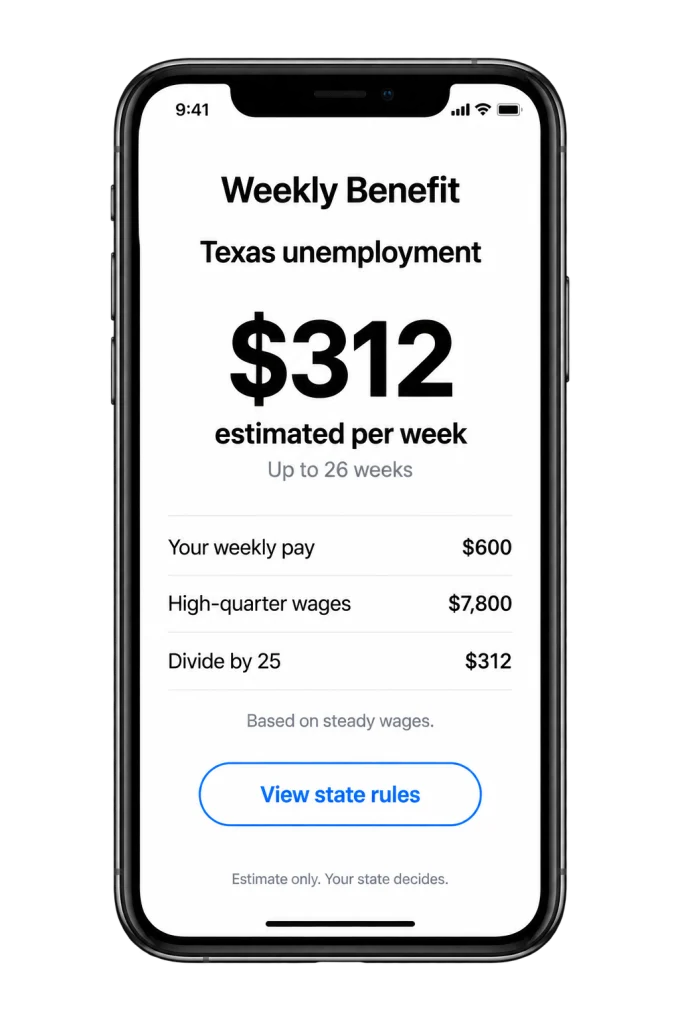
Your high quarter, then the state divisor.
Eligibility and the benefit balance still apply.
See where your wages fall in the state range.
Dated links to the agency behind each calculation.
Here’s where the number comes from.
Illustrative Texas arithmetic for $600 in steady weekly pay, using the 2025 claim rules.
Start with your wages.
Use steady pay for a quick estimate or enter your actual quarters.
Apply the state rule.
The formula, rounding, wage requirements and limits shape the result.
Confirm with the agency.
Use the official source to check eligibility and start your claim.
Same wages. Different benefits.
Unemployment on $600 a week, with four equal quarters and no dependents.
| State | Estimated weekly | Weekly maximum | Up to |
|---|---|---|---|
| California | $300 | $450 | 26 weeks |
| New York | $300 | $869 | 26 weeks |
| Pennsylvania | $302 | $605 | 26 weeks |
| Washington | $383 | $1,208 | 26 weeks |
A few things
you might be wondering.
Is this the amount I will actually receive?
It is an estimate based on the wages and assumptions shown. Your agency checks covered employment, eligibility and any deductions before making an award. Use the linked state source to confirm.
Can I use my actual quarterly wages?
Yes. Open “Use actual wages & more details” in the unemployment calculator and fill all four quarters, using zero where needed. This replaces the steady-pay assumption.
Can I work part-time and still get benefits?
Possibly. States have different earnings and hours rules. Use the partial benefits calculator to see the modeled payment, then follow your agency’s reporting instructions.
Do you need my personal information?
No account or identity details are required. Use wages and work hours only. File a claim through the official agency, never through this website.
One clearer number.
A little more room to plan.
Your state. Your pay. The formula in view.
Find your weekly estimateEstimate only. Your state agency decides.